Artist: Utagawa Hiroshige
Production date: 1851 (Kaei 4)
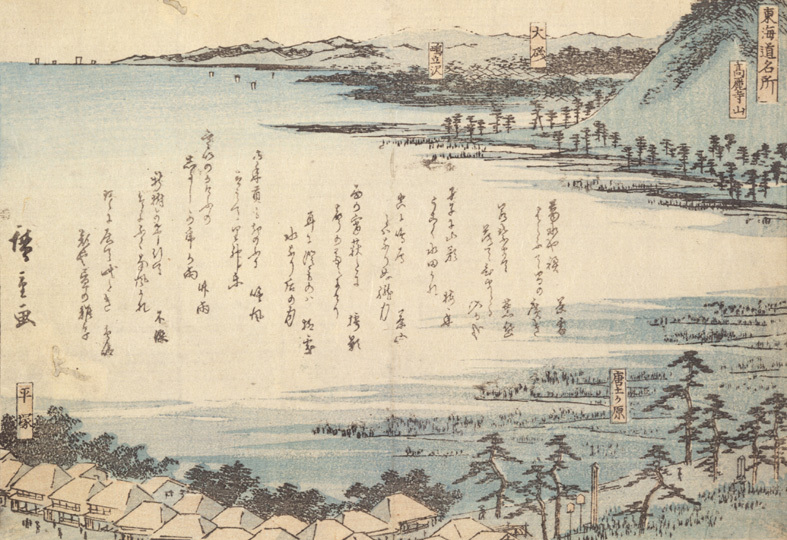
Oiso and Hiratsuka, from the series Famous Places of the Toukaidou
In this picture, the landscape from the Hiratsuka post station to the Oiso post station is illustrated. The “Morokoshi-ga-hara” (Today’s “Tou-ga-hara”) is illustrated at the lower right of the picture. It is said, a group of people from Korean Peninsula moved into this place during 5th century. The mountain illustrated at the right upper part is Kouraiji-san (Mt. Kourai Temple) and its name came from the temple that enshrines Koma-no-Jakkou who came to Japan from an ancient kingdom of Korean Peninsula, Koukuri. At the upper left side from the mountain, there is the land that extends to the Oiso post station and Shigitachi-zawa.
This is an e-baisho (anthology of the seventeen syllables Japanese haiku poems with related pictures) that a variety of poems written by the notable contemporary poets from the haikai poetry circles are allotted with the pictures of famous places of the Toukaidou, as a hokku-shu (anthology hokku or haiku poems ) appears in pictures. This series was the changed title version of “Toukaidou Meisho Hokku-shu (The Hokku-shu of Famous Places of the Toukaidou)”, published by Eiraku-ya Jousuke in 1851, and originally the format of this picture was hanpon or book style. However when this version was made, the landscapes of Edo to Izu were re-edited as a gajou (folded picture book) format, thus the readers can appreciate each landscape as the independent picture. When Hiroshige produced this work, he was also commissioned to paint nikuhitsu-ga (paintings) from Tendou clan. Therefore the expressions such as the composition with natural dimension and bluish pale touch of the color in this series are influenced from the painting expressions.