Fujisawa Net Museum

資料一覧

Artist: Utagawa Hiroshige
Production date: 1851 (Kaei 4)

The view from the Shichiri-ga-hama Beach was often used as the most beloved landscape motif since the two of the most famous places, the Enoshima Island and the Mt. Fuji can be seen from this beach. A town on the right, situated about the gate of the Enoshima Island was Katase. This town was flourished with many visitors to the island and many inns and souvenir shops stood along the approach. A hilly island situated on the left of Katase is the Cape Koyurugi.

This is an e-baisho (anthology of the seventeen syllables Japanese haiku poems with related pictures) that a variety of poems written by the notable contemporary poets from the haikai poetry circles are allotted with the pictures of famous places of the Toukaidou, as a hokku-shu (anthology hokku or haiku poems ) appears in pictures. This series was the changed title version of “Toukaidou Meisho Hokku-shu (The Hokku-shu of Famous Places of the Toukaidou)”, published by Eiraku-ya Jousuke in 1851, and originally the format of this picture was hanpon or book style. However when this version was made, the landscapes of Edo to Izu were re-edited as a gajou (folded picture book) format, thus the readers can appreciate each landscape as the independent picture. When Hiroshige produced this work, he was also commissioned to paint nikuhitsu-ga (paintings) from Tendou clan. Therefore the expressions such as the composition with natural dimension and bluish pale touch of the color in this series are influenced from the painting expressions.

Famous Places of the Toukaidou Shichiri-ga-hama Beach

Artist: Utagawa Hiroshige
Production date: 1851 (Kaei 4)

Enoshima Island, from the series Famous Places of the Toukaidou This picture illustrates Enoshima Island at the time of low tide and the pilgrims heading to the Island are walking on a sand bar. This sand bar was used to be called as “subana”, and the name still remains today. People call the street that leads to this approach Subana-Douri (Subana Street). Today there is a bridge to cross the sea to get to the Enoshima Island on the time of high tide, but during Edo period, when there was no bridge; people crossed the sea by the ships.

This is an e-baisho (anthology of the seventeen syllables Japanese haiku poems with related pictures) that a variety of poems written by the notable contemporary poets from the haikai poetry circles are allotted with the pictures of famous places of the Toukaidou, as a hokku-shu (anthology hokku or haiku poems ) appears in pictures. This series was the changed title version of “Toukaidou Meisho Hokku-shu (The Hokku-shu of Famous Places of the Toukaidou)”, published by Eiraku-ya Jousuke in 1851, and originally the format of this picture was hanpon or book style. However when this version was made, the landscapes of Edo to Izu were re-edited as a gajou (folded picture book) format, thus the readers can appreciate each landscape as the independent picture. When Hiroshige produced this work, he was also commissioned to paint nikuhitsu-ga (paintings) from Tendou clan. Therefore the expressions such as the composition with natural dimension and bluish pale touch of the color in this series are influenced from the painting expressions.

Famous Places of the Toukaidou Enoshima Island

Utagawa Hiroshige
O-ban polychrome print, 25.6 x 38.5cm
1833-1835 (Tempou 4-6)

Hiroshige established the position as a premier landscape artist with the superior compositional ideas and the point of view of this masterpiece, from the series “Fifty-three Stations of the Toukaidou”. Ichi-no-Torii or the First Torii Gate of Enoshima Island situated at Fujisawa Post Station is illustrated with the Yugyouji-temple at its background. The bridge behind the Torii Gate is Daigiri Bridge (present day Yugyouji Bridge). People on the bridge are the pilgrims to Mt. Oyama and people just going through the Torii Gate with the sticks in their hands are the pilgrims to Enoshima Island. This work tells the contemporary viewers that Fujisawa Post Station was alive with tourists and the pilgrims for both sites.

Utagawa Hiroshige
Kansei 9~Ansei 5 (1799~1858)
Hiroshige was a pupil of Utagawa Toyohiro. He also studied varieties of painting styles from Kano school, nan-ga (southern Chinese painting style), and Shijō school. He was active as an ukiyo-e artist from Bunsei 1 to his death (1818~1858). He first produced pictures of beautiful women, Kabuki actors and worriers, but from the Tempō era he was acknowledged as a leading landscape artist. He published many pictures of famous places such as the series “Fifty-three Stations of the Tokaido”. Hiroshige’s the other fortes were kachoga (picture of birds and flowers) and animal pictures.

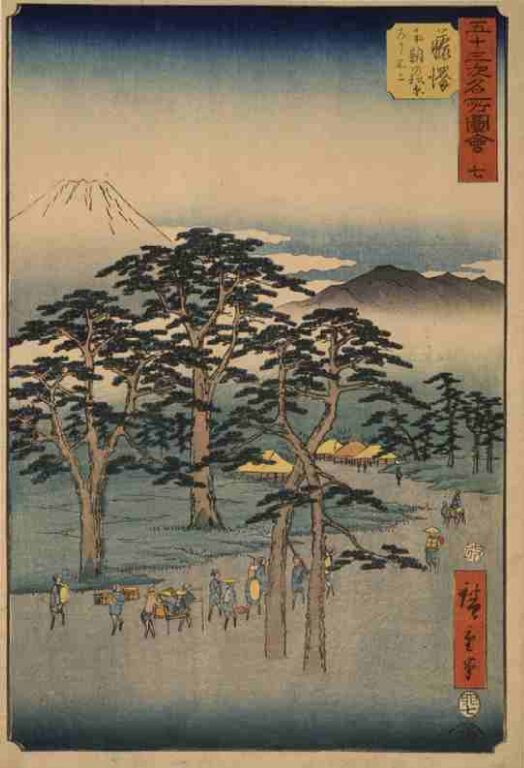
東海道五拾三次之内 藤沢(保永堂版)

Fujisawa, from the series Fifty-three Stations of the Toukaidou (Hoeidou edition)

Utagawa Hiroshige
The production date:1858

Harimaze-e (Paste the mixed pictures) was the picture that several famous places (landscapes, local specialties, stories, etc.) are illustrated in a single picture, and Hiroshige produced several harimaze-e works that illustrated the places all over Japan, including places along the Toukaidou Highway.
In the first painting, from the top layer, Ninhonbashi Bridge (A summer’s custom, a tea stand that provides the barley hot tea.), Shinagawa (Matoi, or a straw craft, which was a local product of Omori. People brought back matoi as a souvenir for the pilgrimage to Mt. Oyama), Kanagawa (A scenery of port), Hodoga-ya (Tome-on’na, or the women who tried to bring in the customers to their inns. People stayed overnight at Hodogaya, before they go back to Edo.), and Kawasaki (Pear, a local specialty of Daishi-gawara) are illustrated.
In the second painting, from the right below, Totsuka (Yakimochi or a toasted rice cake. Since yakimochi was sold at the border of Shinano village and Hirado village, along the slope, this slope was named as Yakimochi Slope), Fujisawa (A woman serving food for the customers of inns), Yotsuya-oiwake (Yotsuya of Fujisawa city. Oiwake is a fork of road. Oiwake as the place to change human labors and horses are symbolically illustrated with a palanquins and legs of horses), Isehara (A city located at the foot of Mt. Oyama) and Otaki (One of the falls located in Mt. Oyama. Pilgrims purify their body by standing under the waterfall.) are illustrated.
In the third painting, from the right below, Tamura (A ferry to cross the Sagami River from Yotsuya to Oyama), Koyasu (A village located along the road to Mt. Oyama between Isehara and Mt. Oyama.), Mae Fudou of Oyama (A hall located in front of Oyama Temple.), Sekison-ji Raigou-dani (A place where at the time sun sets into Mt. Fuji located at west, the atmosphere of “the decent of Amida Nyorai” emerges.), and Ryoben Waterfall (One of the waterfalls located in Mt. Oyama. It is said that Saint Ryoben purified his body in this waterfall when he opened the Oyama Temple in this place.) are illustrated.
All the famous places and specialties invite viewers to the pilgrimage to Mt. Oyama.
Traveling along Oyama Road with Harimaze-e Pictures


Page Top