Fujisawa Net Museum

資料一覧

Artist: Utagawa Hiroshige
Production date: 1851 (Kaei 4)

The High Peaks of Hakone, from the series Famous Places of the Toukaidou.

In this picture, mountains of Hakone, the Myouban-yama (Mt. Myouban) on the right, the Koma-ga-take (Mt. Koma) in the middle and the Kan’muri-ga-take (Mt. Kan’muri) on the left and a canyon are illustrated. Mt. Myouban was considered to be located near today’s Kami-yama (Mt. Kami), and known for a large yield of alum (Alum is myouban in Japanese). In fact, alum produced from this mountain was a souvenir of Hakone. This is an e-baisho (anthology of the seventeen syllables Japanese haiku poems with related pictures) that a variety of poems written by the notable contemporary poets from the haikai poetry circles are allotted with the pictures of famous places of the Toukaidou, as a hokku-shu (anthology hokku or haiku poems ) appears in pictures. This series was the changed title version of “Toukaidou Meisho Hokku-shu (The Hokku-shu of Famous Places of the Toukaidou)”, published by Eiraku-ya Jousuke in 1851, and originally the format of this picture was hanpon or book style. However when this version was made, the landscapes of Edo to Izu were re-edited as a gajou (folded picture book) format, thus the readers can appreciate each landscape as the independent picture. When Hiroshige produced this work, he was also commissioned to paint nikuhitsu-ga (paintings) from Tendou clan. Therefore the expressions such as the composition with natural dimension and bluish pale touch of the color in this series are influenced from the painting expressions.

Famous Places of the Toukaidou mountains of Hakone

Artist: Utagawa Hiroshige
Production date: 1851 (Kaei 4)

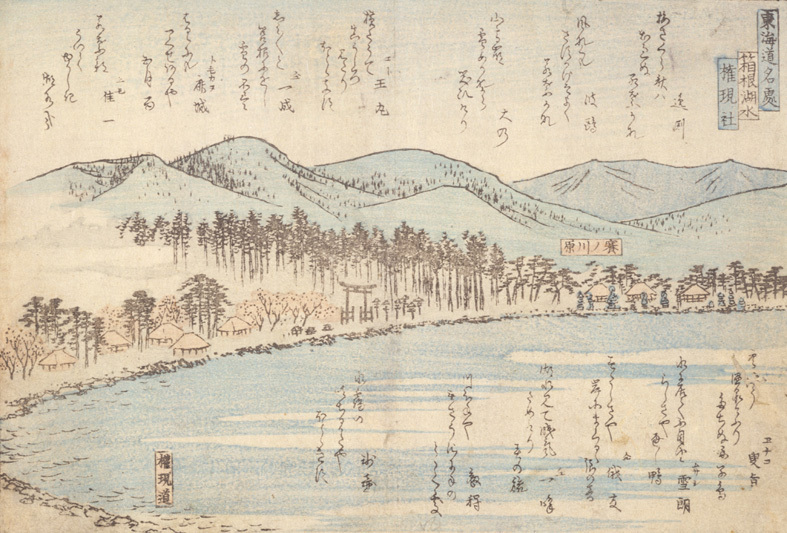
The Lake at Hakone and Gongen-sha (Hakone Shrine), from the series Famous Places of the Toukaidou.

With the mountains of Hakone at its background, the landscape of the Lake Ashino-ko is illustrated. The horizontal indication at the right of the picture “Sai-no Kawara” (Riverside of Sai: Children’s Limbo) was a famous for the Mecca of the devotees for Jizou Shinkou (Jizou Worship. Jizou is a bodhisattva who looks over children, travelers, and the underworld.), and it is said many images of Buddha and pagodas made by stones are situated by the lake. The sign on the left below is the indication of “Gongen-dou”, an approach that leads to Hakone Shrine known as Hakone Gongen.


This is an e-baisho (anthology of the seventeen syllables Japanese haiku poems with related pictures) that a variety of poems written by the notable contemporary poets from the haikai poetry circles are allotted with the pictures of famous places of the Toukaidou, as a hokku-shu (anthology hokku or haiku poems ) appears in pictures. This series was the changed title version of “Toukaidou Meisho Hokku-shu (The Hokku-shu of Famous Places of the Toukaidou)”, published by Eiraku-ya Jousuke in 1851, and originally the format of this picture was hanpon or book style. However when this version was made, the landscapes of Edo to Izu were re-edited as a gajou (folded picture book) format, thus the readers can appreciate each landscape as the independent picture. When Hiroshige produced this work, he was also commissioned to paint nikuhitsu-ga (paintings) from Tendou clan. Therefore the expressions such as the composition with natural dimension and bluish pale touch of the color in this series are influenced from the painting expressions.

Famous Places of the Toukaidou The Lake at Hakone and Gongen-sha (Hakone Shrine)

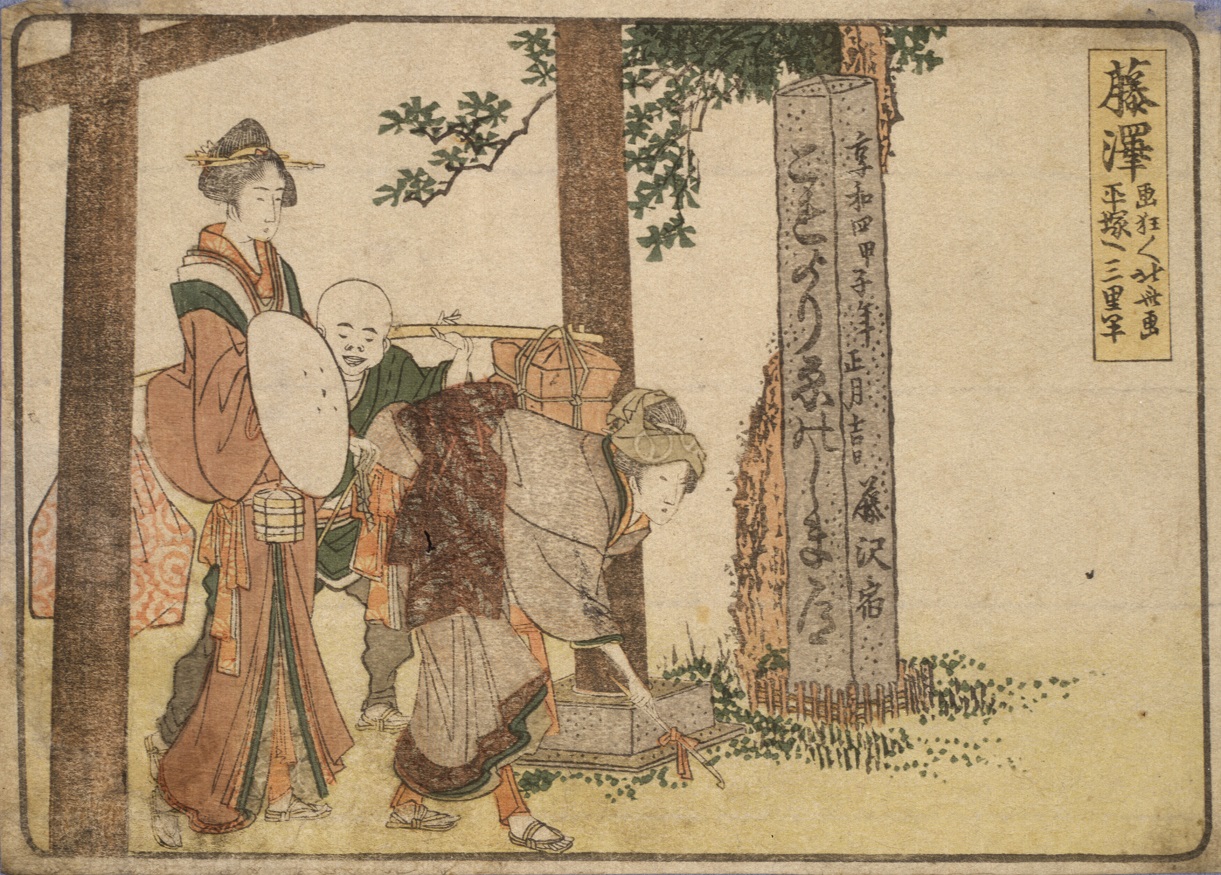
Katsushika Hokusai

The production date: 1804 (Kyouwa 4/ Bunka1)
No Publisher’s seal

Hokusai didn’t produce any O-ban (large) size ukiyo-e print in the series of Fifty-three Station of Toukaidou. He usually produced the horizontal Ko-ban (small) size print. Unlike Utagawa Hiroshige, whose main subjects were the scenery and landscape, Hokusai focused more on the travelers’ outfits and the cultures and the customs of each station, and this gave a distinctive taste to his works. When he started to produce the Toukaidou series, he was commissioned by a group of kyouka poets and produced a surimono, a privately issued luxurious work “Spring Event of the Fifty-three Station” with the kyouka poems printed on the right.

Let’s closely look at the each station. At “Hodogaya”, a man wipes off the dirt from his horse’s feet after it worked at a muddy field, tells the viewers the arrival of the spring. At “Totsuka”, a scene of departure is illustrated. Two men are about to leave an inn and a woman sends off the men rather sadly. At “Fujisawa”, women travelers are heading to Enoshima Island, and they are about to go through the First Torii Gate of the Enoshima Island. The woman walking at the front is holding a cigarette pipe, and a thread of red cloth is tied to it. It was a charm to avoid small pox, which was a most dangerous disease at that time. The guidepost indicates “From now on, the road of Enoshima”, and from the writing on this post “Kyouwa 4 (1804)”, the production date of this series can be identified.
At “Hiratsuka”, the farmers are resting in a tree shade and their tools, such as a mowing sickle and basket are illustrated. The season is the beginning of spring but it seems the air is still chilly. At “Oiso”, there is a man trying to lift a gigantic rock. The word “The Tiger Stone” is inscribed on the Rock. This picture is based on a legend of Tora-gozen, or the Tiger lady from this post station.(Tora-gozen appears on “Soga Monogatari (The Soga Brother’s Story)”, and she was considered to spread this local story nationwide).
At “Odawara”, the Uirou vendor and the distant view of Odawara castle are illustrated. “Uirou” is a name of medicine still distributed today and one of the famous products of Odawara. (Uirou is also name of a sweet as well, but the two are different things.) A Kabuki actor Ichikawa Danjurou II who has a disease that caused him a trouble when he said the line on stage with the cough and sputum was cured by Uirou. It was quite a famous story and after he was cured, he made a play “The Uirou Vendor” and acted by himself around the time this picture was produced. A woman on a picture seems to imitate Danjurou.

Fifty-three Stations of the Toukaidou Highway Fujisawa


Page Top