Fujisawa Net Museum

資料一覧

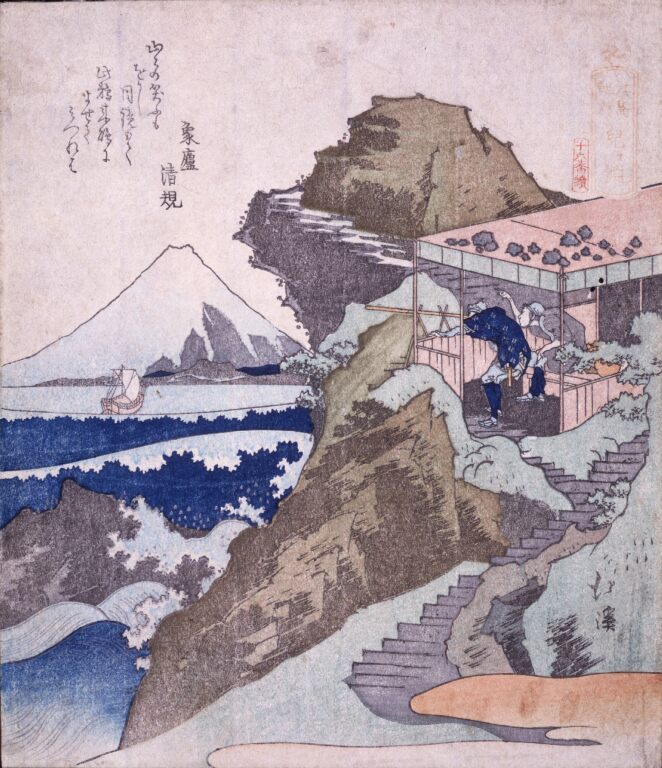
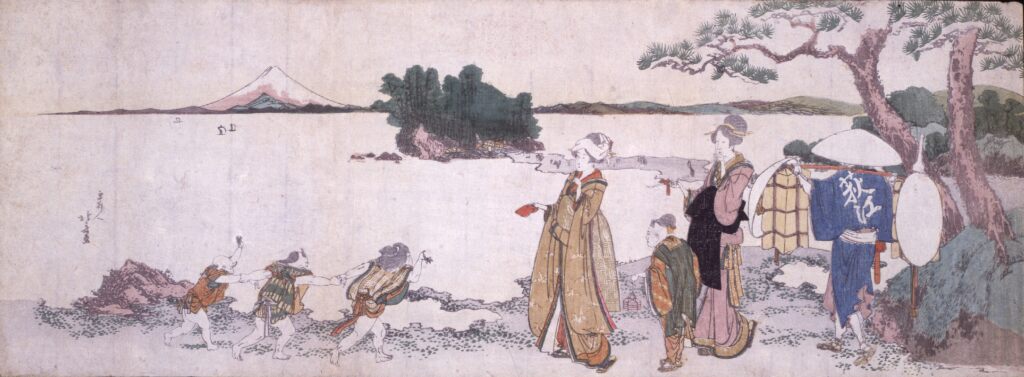
Artist: Totoya Hokkei Production date: 1830-1844 (early Tempou era) No publisher’s seal A man is looking at a view through his telescope from Enoshima Island. The Edo period record indicates that viewing scenery through telescope was a very popular custom during Edo period. As a typical surimono work, the lines of wave crash, surface texture of rocks and the kimono pattern of a man on the right are luxuriously decorated with gindei (a pigment that contains silver). “Chronicle of a Journey to Enoshima” is a series of surimono that illustrated landscapes and products related to Enoshima Island. Surimono is high quality woodblock prints that include both kyouka poems (Comic verse composed of 31 syllables) and illustrations related to the poems. Since surimono was produced not for sale but made privately by the group of kyouka poets, the artists who produced the illustrations fully expressed their supreme talents and skills such as detailed curving techniques and high skill of the printing technique in a small format. The indications in the several works specify that there were originally 16 works in this series. However, only 14 works, “Takanawa, the starting point”, “Samezu”, “Omori”, “Kamata”, “Rokugou”, “Tsurumi”, “Kanagawa”, “Hamagawa”, “Shimo-no-miya”, “Kami-no-miya”, “Hongu”, “Chigo-ga-buchi”, “Manaita-iwa”, and “Ryudou” are currently discovered. This series was produced for the memory of kyouka poetry circle’s journey to Enoshia Island. The illustrations were produced by Totoya Hokkei and he was a pupil of Katsushika Hokusai. Hokkei was known for his premier talent with surimono, especially related to kyouka, and it is said his skill even surpassed that of Hokusai.

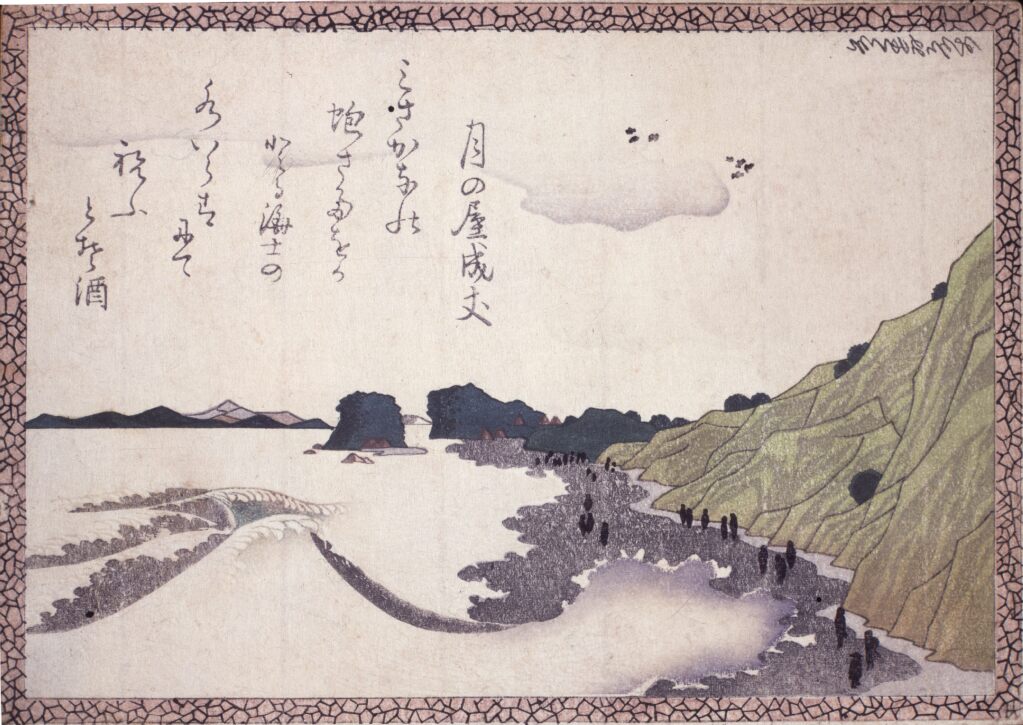
魚屋北溪 江島記行 兒ヶ淵

Chronicle of a Journey to Enoshima Chigo-ga-buchi Abyss

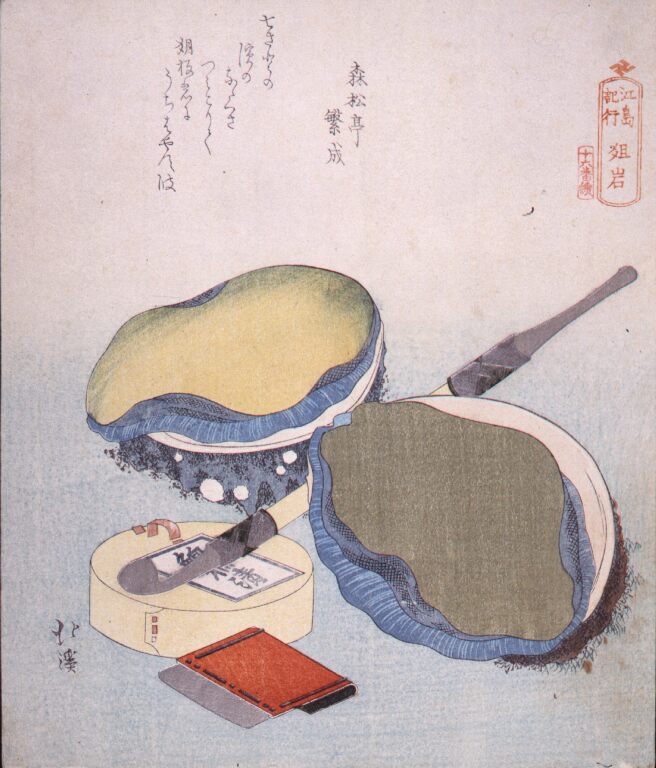
Artist: Totoya Hokkei Production date: 1830-1844 (early Tempou era) No publisher’s seal In this scene, land is expressed not through the depiction of famous landscape of Manaita-iwa, or the rock looks like a cutting board, but instead, the land is expressed with the local specialty of Enoshima Island: The abalone and the abalone kasuzuke (the pickles with sake lees seasoning) in a wooden circular box. Between the local products, a Japanese smoking pipe (kiseru) and a red steel to light a fire are illustrated. Detail parts are carefully decorated: The smoking pipe’s metal shank is decorated effectively with a silver pigment and the lines of small sea shells stick to an abalone are expressed with the emboss effect. “Chronicle of a Journey to Enoshima” is a series of surimono that illustrated landscapes and products related to Enoshima Island. Surimono is high quality woodblock prints that include both kyouka poems (Comic verse composed of 31 syllables) and illustrations related to the poems. Since surimono was produced not for sale but made privately by the group of kyouka poets, the artists who produced the illustrations fully expressed their supreme talents and skills such as detailed curving techniques and high skill of the printing technique in a small format. The indications in the several works specify that there were originally 16 works in this series. However, only 14 works, “Takanawa, the starting point”, “Samezu”, “Omori”, “Kamata”, “Rokugou”, “Tsurumi”, “Kanagawa”, “Hamagawa”, “Shimo-no-miya”, “Kami-no-miya”, “Hongu”, “Chigo-ga-buchi”, “Manaita-iwa”, and “Ryudou” are currently discovered. This series was produced for the memory of kyouka poetry circle’s journey to Enoshia Island. The illustrations were produced by Totoya Hokkei and he was a pupil of Katsushika Hokusai. Hokkei was known for his premier talent with surimono, especially related to kyouka, and it is said his skill even surpassed that of Hokusai.

魚屋北溪 江島記行 俎岩

Chronicle of a Journey to Enoshima Manaita-iwa (Cutting Board Rock)

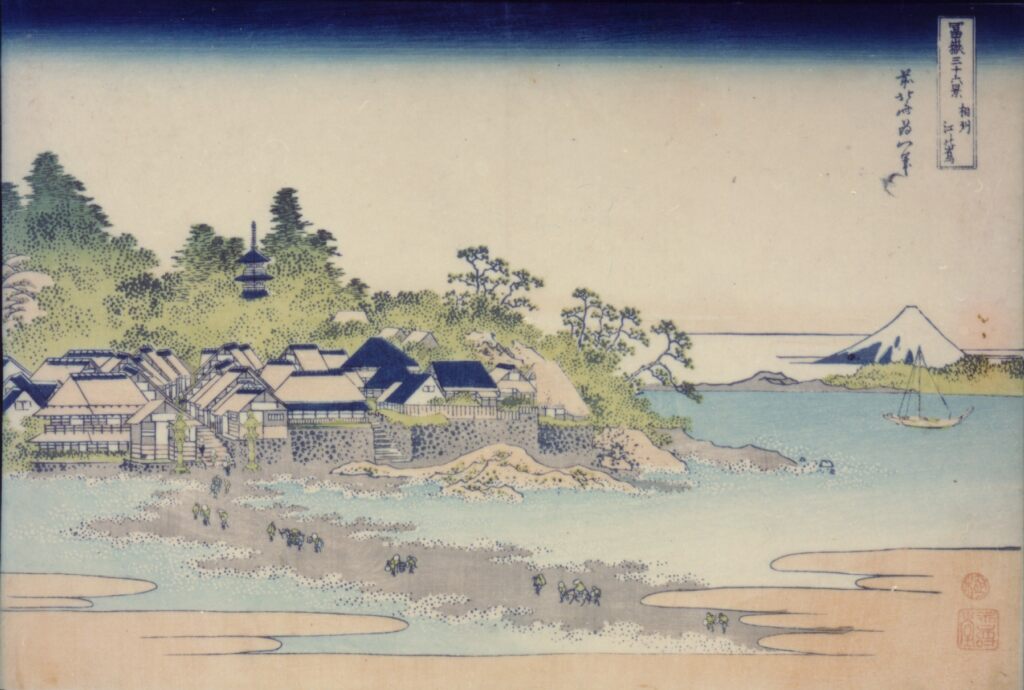
Artist: Katsushika Hokusai 1830-1844 (c.Tempou era), Publisher: Eijudou Thirty-six Views of Mt. Fuji is the ultimate masterpieces of Hokusai, and the thirty-six pieces originally published were called “top” while the ten pieces followed the original, because of the high reputation of the series, were called “bottom”. As a total, forty-six works of this series were published. The works of Thirty-six Views of Mt. Fuji are classified into three categories according to the picture mood: the first category is the painting with Yamato-e style tradition, the second category is picture with the Chinese ink painting tradition and the third category is the picture with the Western perspective expression. This particular picture is classified into the Chinese ink painting tradition inherits many elements from it. The Enoshima Island is illustrated as if it is connected to the mainland, expressed in very flat way, reminds viewers of the Chinese landscape painting. Katsushika Hokusai Hōreki 10~Kaei 2 (1760~1849) Hokusai was a pupil of Katsukawa Shunsho; also said to have studied under Kano Yusen, Tsutsumi Torin, and Sumiyoshi Hiroyuki. He produced of wide variety of art and media. Later in his life, he focused more on the paintings and worked beyond the framework of the established ukiyo-e. He had students such as Hokuba, Hokkei, Hokuju and Shinsai. He had a long career period started from An’ei 8 till his death (1779-1849).

葛飾北斎 冨嶽三十六景 相州江の嶌

Enoshima Island in Sagami Province, from the series Thirty-six Views of Mt. Fuji


Page Top