Fujisawa Net Museum

資料一覧

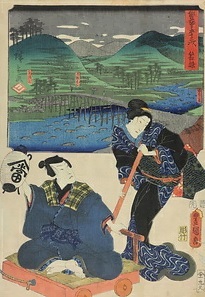
Utagawa Sadahide 1863 Explicación general Esta serie de carretera Toukaidou, conocida como la serie “Gojoraku Toukaidou”, fue publicada en ocasión a la procesión del Decimocuarto Shogun Tokugawa Iemochi desde Tokio hasta Kioto acontecida en 1863 (Bunkyu 3). En esta serie, todas las obras ilustran a los samuráis y las procesiones de los Daimyo. Hay 162 obras producidas en esta popular serie, ya que se ilustran no sólo las estaciones sino también los lugares famosos a lo largo de la carretera Toukaidou. Estas obras fueron producidas por los 16 artistas más famosos de aquella época incluyendo a Toyokuni III Utagawa y Hiroshige II Utagawa. The Toukaidou: Fujisawa, Yugyouji Temple In this picture, a party proceeding in front of the Yugyouji Temple is illustrated. Besides the title, the signs “The Direction for Edo” and “Kamakura Road” are indicated. In the wood beside the Yugyouji Temple, the signs ”Oguri Hall” and “The Grave of Ten Heroes of Oguri” based on the legendary tale of “Oguri-Hangan and Princess Terute” are illustrated. Below, at the right, beside the First Torii Gate to Enoshima, the indication of “Enoshima-michi (The Road to Enoshima Island)”is illustrated. As a master of bird’-eye view picture, Sadahide was conscious with the topographical contents of this land. This series was published with the event of the Fourteenth Shogun Tokugawa Iemochi’s procession from Tokyo to Kyoto (Shogun’s official visit to Emperor) that took place in 1863 (Bunkyu 3) and it is known as “Gojouraku Toukaidou (Samurai’s procession along the Toukaidou Highway)”. Iemochi’s visit was an unusual event since last time Tokugawa Shogun visited Emperor was 229 years ago when the Third Shogun Tokugawa Iemitsu visited Emperor. Therefore this event got a huge attention from the people of Edo. This series was very popular that 162 works were produced within this series. Since 16 artists from Utagawa School were involved for the production, it is considered that the publisher wanted to produce many works within a short period of time.

東海道名所之内 ふちさハ 遊行寺

Cincuenta y tres estaciones de la autopista Toukaidou Fujisawa, Templo Yugyouji

Artist: Totoya Hokkei Production date: 1830-1844 (early Tempou era) No publisher’s seal A man is looking at a view through his telescope from Enoshima Island. The Edo period record indicates that viewing scenery through telescope was a very popular custom during Edo period. As a typical surimono work, the lines of wave crash, surface texture of rocks and the kimono pattern of a man on the right are luxuriously decorated with gindei (a pigment that contains silver). “Chronicle of a Journey to Enoshima” is a series of surimono that illustrated landscapes and products related to Enoshima Island. Surimono is high quality woodblock prints that include both kyouka poems (Comic verse composed of 31 syllables) and illustrations related to the poems. Since surimono was produced not for sale but made privately by the group of kyouka poets, the artists who produced the illustrations fully expressed their supreme talents and skills such as detailed curving techniques and high skill of the printing technique in a small format. The indications in the several works specify that there were originally 16 works in this series. However, only 14 works, “Takanawa, the starting point”, “Samezu”, “Omori”, “Kamata”, “Rokugou”, “Tsurumi”, “Kanagawa”, “Hamagawa”, “Shimo-no-miya”, “Kami-no-miya”, “Hongu”, “Chigo-ga-buchi”, “Manaita-iwa”, and “Ryudou” are currently discovered. This series was produced for the memory of kyouka poetry circle’s journey to Enoshia Island. The illustrations were produced by Totoya Hokkei and he was a pupil of Katsushika Hokusai. Hokkei was known for his premier talent with surimono, especially related to kyouka, and it is said his skill even surpassed that of Hokusai.

魚屋北溪 江島記行 兒ヶ淵

Chronicle of a Journey to Enoshima Chigo-ga-buchi Abyss


Page Top